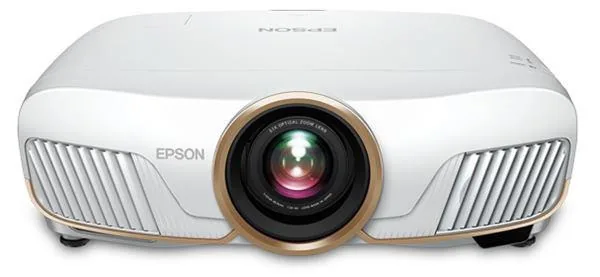
Epson Home Cinema 2350 projectorHome theater~$1,399

Epson

Epson Home Cinema 2350

A 1080p three-chip 3LCD lamp projector with Android TV baked in, aimed at a bright family room rather than a blacked-out theater. The 1.62x zoom and long throw range let it sit on a shelf at the back of most rooms, and 2,800 ISO lumens is genuinely enough for evening viewing with a lamp on.

Approx. price

~$1,399

snapshot, not a live price

Brightness

2,800

ISO 21118

Screen at 10 ft

63–103 in

16:9 diagonal, estimated from the throw ratio

Input lag

18 ms

fastest published mode

Light source

Lamp

4,500 h rated

Best for: A bright living room where a shelf at the back of the room is the only place a projector can go

Specifications

Type
Home theater
Throw ratio
1.34–2.17:1
Zoom
1.62x
Input lag (4K/60)
19 ms
Input lag (1080p/120)
18 ms
HDR formats
HDR10, HLG
Built-in streaming
Android TV
Speakers
10 W total
HDMI
2 × HDMI 2.0
Weight
9 lb
Released
2022

Features

  • Android TV built in
  • 1.62x manual zoom
  • Digital keystone and image shift
  • 10 W speaker with Bluetooth out
  • Frame interpolation
  • 18 ms at 1080p/120

What it does well

  • 2,800 ISO lumens is a real, standardized number, and it is enough light for a 100-inch screen with lamps on
  • The 1.62x zoom plus a 1.34-2.17 throw range covers almost any room depth without moving furniture
  • Three-chip 3LCD means color brightness equals white brightness, so colors do not dim the way single-chip DLP can
  • 18 ms input lag at 1080p/120 makes it usable for console gaming, which is unusual at this price
  • Android TV is licensed and includes Netflix, so no dongle hangs off the back

What it gives up

  • 1080p native with no pixel shift — it accepts a 4K signal and downscales it
  • 36 dB fan noise is audible in a quiet room; eco mode drops it to 28 dB and costs brightness
  • The 230 W lamp is a consumable: 4,500 hours typical, and replacements are a recurring cost laser models do not have
  • No optical lens shift, so a crooked install has to be corrected digitally, which throws away resolution
  • It will not accept 4K/60 with HDR — the supported-mode table allows 4K/30 with HDR or 1080p/60 with HDR and enhancement, which the marketing does not make obvious

The two lists above are read off manufacturer specifications and published measurements, not from owner reports. Where owner discussion has been collected it appears separately below, so the two are never mistaken for each other.

What owners say

Owners recommend this as a bright, colour-rich entry point and then immediately qualify it. The praise is consistent: people upgrading from older 1080p projectors describe the colour brightness as the obvious improvement, and owners who cross-shopped a sharper 4K DLP at similar money report preferring this projector's colour even at lower resolution.

The qualification that matters most is a signal-support limit that is easy to miss. The projector does not accept 4K at 60 Hz with HDR — the supported-mode table allows 4K/30 with HDR, or 1080p/60 with HDR and Epson's enhancement processing. Owners who bought it expecting 4K/60 HDR describe the marketing as misleading and one considered returning it over the discovery.

The practical complaints are fan noise and placement. Owners describe eco mode as the only comfortable setting for dialogue-driven content, and report very little vertical adjustment — one shimmed the rear feet with a board to bring the image into range. All the adjustments are manual, which owners find fiddly to square up.
What owners like

  • Colour brightness is the thing owners upgrading from older 1080p projectors mention first — several describe the colour output as dramatically better than what they replaced
  • Owners report console gaming works well, with response and lag not being an issue in practice
  • The long 1.34 to 2.17 throw range and 1.62x zoom gets praise from owners fitting it into awkward spaces, including shallow nooks
  • Owners note the intake is on one side and the exhaust on the other, which makes it easier to place in a confined shelf or alcove
  • Owners comparing it against a sharper 4K DLP at the same price said they preferred this one's colour and accepted the softer resolution

Common complaints

  • It does not accept 4K/60 with HDR — the supported-mode table allows 4K/30 with HDR or 1080p/60 with HDR and enhancement, and owners describe the marketing around this as misleading
  • Owners report very limited vertical adjustment; one had to shim the rear feet with a board to bring the image into range
  • The fan draws consistent complaints — owners describe eco or low power as the only comfortable setting for quiet content
  • Owners report that all the adjustments are manual and fiddly to square up
  • There are scattered reports of focus uniformity problems, and owners note the lens is not as good as the one in Epson's next model up

Questions owners ask about the Epson Home Cinema 2350

Does it really do 4K?

It is a 1080p projector with Epson's 4K enhancement processing, and the supported-mode table matters: 4K/60 with HDR is not on it. You can send 4K/30 with HDR, or 1080p/60 with HDR and enhancement. Owners who expected full 4K/60 HDR describe this as the main disappointment.

Is it loud?

Owners say yes in normal mode — 36 dB is the published figure — and that eco or low power is the setting they actually use for quiet content. In a light-controlled room the lower mode is bright enough, which makes this less of a problem than it sounds.

How much can I move the image without moving the projector?

Very little. Owners report having to physically shim or reposition the projector to bring the image into range, and experienced owners point people at Epson's next model up specifically for its real optical lens shift and wider zoom.

Is it any good for gaming?

Owners running current consoles report no problem with response or lag — 18 ms at 1080p/120 is the published figure. The caveat is the same signal limit: no 4K/60 with HDR.

How does it compare with a 4K DLP at the same price?

Owners who ran both describe the DLP as sharper on small text and duller on colour, and this one as having far higher colour brightness at lower effective resolution. Which is better depends on whether you sit close enough to resolve the difference.

Others in the same part of the catalog

More from Epson →

← Back to the catalog