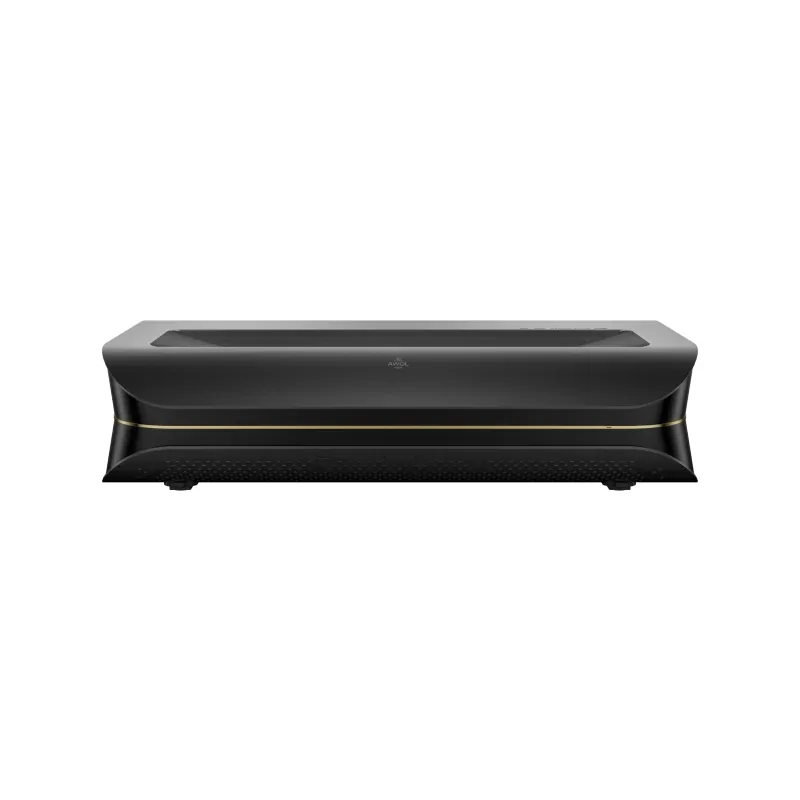
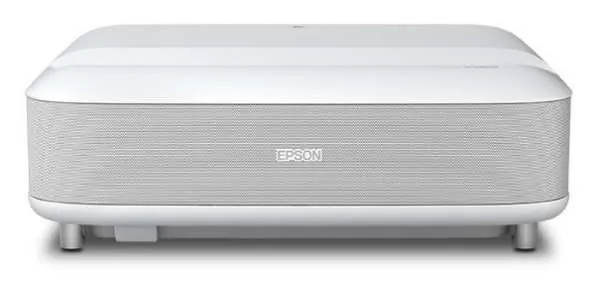
Epson EpiqVision Ultra LS650 projectorUST laser TV~$2,499

Epson

Epson EpiqVision Ultra LS650

The cheap way into a laser TV, and the one that behaves most like furniture: 16 lb, a console-style cabinet, Yamaha 2.1 audio with a subwoofer, and Android TV. It is a 1080p projector that accepts 4K signals, and the 0.28 throw ratio means it sits further from the wall than a true 0.2-class UST.

Approx. price

~$2,499

snapshot, not a live price

Brightness

3,600

ISO 21118

100-inch screen at

24 in

lens to screen, estimated from the throw ratio

Light source

Laser-phosphor

20,000 h rated

Best for: A bright den where a 100-inch picture matters more than pixel count

Specifications

Type
UST laser TV
Light source
Laser-phosphor
Light source life
20,000 hours
Zoom
Fixed lens
HDR formats
HDR10, HLG
Built-in streaming
Android TV
Speakers
10 W total
HDMI
2 × HDMI 2.1
Weight
16.3 lb
Released
2023

Features

  • Android TV with Google Assistant
  • Yamaha 2.1 audio with subwoofer
  • 20,000-hour laser
  • Two HDMI 2.1 inputs
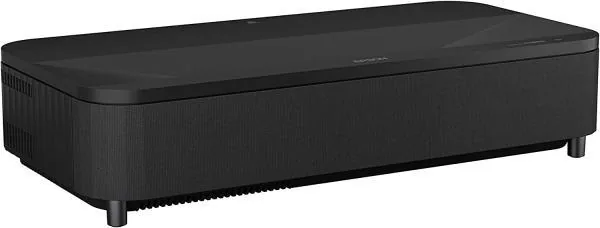
  • Cabinet styling in white or black

What it does well

  • 3,600 ISO lumens for $2,499 is the most standardized brightness per dollar of any laser TV here
  • 16.3 lb makes it the only UST in this catalog one person can reposition without help
  • The Yamaha 2.1 system includes an actual subwoofer, which most laser TVs skip
  • Android TV is licensed, so Netflix works natively rather than via a dongle

What it gives up

  • 1080p panels with no pixel shift — 4K goes in, 1080p comes out
  • The 0.28 throw ratio needs roughly twice the wall clearance of a 0.16-class UST
  • 36 dB is the loudest normal-mode fan figure of the laser TVs here
  • Single-laser phosphor, so no wide-gamut tri-laser color
  • No 3D, no Dolby Vision, no HDR10+
  • The lens is completely fixed — no zoom at all — so one screen size means exactly one throw distance

The two lists above are read off manufacturer specifications and published measurements, not from owner reports. Where owner discussion has been collected it appears separately below, so the two are never mistaken for each other.

What owners say

Owner discussion of this projector is mostly a value calculation against Epson's brighter flagship laser TV, and owners run the numbers openly: if the flagship discounts to within a few hundred dollars, several argue the cheaper model stops making sense. The counter-argument owners give is that this one is smaller, lighter, and — a detail they raise repeatedly — has an eARC port that the flagship does not.

The reason owners look at Epson ultra-short-throws at all is three-chip 3LCD. There is no colour wheel, so there is no possibility of the rainbow artifact, which owners who see it name as the single reason they will not buy a DLP laser TV. Epson's ultra-short-throws also sit closer to the wall than the 0.25-class rivals, which owners note can otherwise protrude 60 cm or more into the room at 120 inches and drive people to build motorised sliding shelves.

The warning owners give is about placement. The throw distance is fixed with no zoom at all, so the projector has to sit in exactly one position for a given screen size — and more than one owner found their furniture or their throw distance simply did not accommodate it.
What owners like

  • Owners highlight that it has an eARC port, which they consider a meaningful advantage over Epson's brighter ultra-short-throw model
  • Three-chip 3LCD means no possibility of the rainbow artifact, which owners sensitive to it name as the reason they buy Epson ultra-short-throws specifically
  • Its throw ratio keeps the cabinet closer to the wall than the 0.25-class rivals, which owners point out can otherwise stick 60 cm or more out into the room at 120 inches
  • It is physically smaller and lighter than Epson's flagship laser TV, which owners with shallow furniture treat as the deciding factor
  • The price step below the flagship makes projector-and-screen bundles more affordable, which owners note softens the cost of the matched screen

Common complaints

  • The throw distance is completely fixed with no zoom, so owners warn the projector has to be placed in an exact position relative to the screen
  • At 3,600 lumens against the flagship's 4,000, owners question whether the saving is large enough to justify stepping down when the flagship goes on sale
  • Owners note it did not fit their throw or cabinet dimensions, which is a reminder that ultra-short-throw geometry is unforgiving

Questions owners ask about the Epson EpiqVision Ultra LS650

How does it compare with Epson's brighter laser TV?

It is 3,600 lumens against 4,000, smaller and lighter, and cheaper — and owners point out it has an eARC port the brighter model lacks. When the flagship discounts heavily, owners argue the gap narrows to the point where the flagship is the better buy.

Will I see the rainbow effect?

No. It uses three 3LCD panels, so all three colours are on screen simultaneously and the colour-sequential mechanism that produces the artifact does not exist. Owners who are sensitive to it seek out Epson ultra-short-throws for exactly this reason.

How exact does the placement have to be?

Exact. There is no zoom at all, so the throw distance for a given screen size is a single number rather than a range. Owners advise measuring against the throw ratio before buying, and note that more than one buyer found their furniture would not accommodate it.

How far into the room does the cabinet stick out?

Less than most. Owners point out that the 0.25-throw-ratio rivals can protrude 60 cm or more into the room for a 120-inch image, to the point where people build motorised sliding shelves to hide them. Epson's shorter throw ratios sit closer to the wall.

Is it 4K?

No. It has 1080p panels with no pixel shifting; it accepts a 4K signal and downscales it. Epson's brighter laser TV does pixel-shift. Owners weighing the two treat that as one of the real differences alongside brightness.

Others in the same part of the catalog

More from Epson →

← Back to the catalog